|
|
|
Ticket and private guided visit Gallery of the Academy and Uffizi in Florence: buy skip-the-line tickets online
Ticket and private guided visit Gallery of the Academy and Uffizi in Florence: buying skip-the-line tickets online for the visit. Collect your ticket at the entrance and skip the line.
Book now and skip the line |
 Ticket and private guided visit Gallery of the Academy and Uffizi - Florence Ticket and private guided visit Gallery of the Academy and Uffizi - Florence
Ticket and private guided visit Gallery of the Academy and Uffizi: € 199 per person.
Book now and skip the line
The Uffizi Gallery Collection includes works dating from the Middle Ages to the Renaissance. Among the exhibited artists Giotto, Piero della Francesca, Beato Angelico, Mantegna, Leonardo, Raphael, Michelangelo, Filippo Lippi, Botticelli and Caravaggio.
The history of the Uffizi Gallery is linked to the Medici family, bankers who rose to power in the 14th century and governed Florence for centuries, collecting works of art by the greatest artists of the time.
The Galleria dell'Accademia collects sculptural and pictorial works from the Renaissance. Among the exhibited artists Donatello, Luca della Robbia, Verrocchio, Michelangelo, Cellini, Giambologna, Paolo Uccello, Botticelli, Perugino, Filippino Lippi, Ghirlandaio.
But certainly a visit is a must for art lovers because the Gallery houses Michelangelo's David, taken away from Piazza della Signoria in 1873 and exhibited here in 1882.
The history of the Galleria dell'Accademia in Florence begins in 1784 when the sixteenth-century Academy of Design Arts was reformed.
The Gallery was born in 1784 at the behest of the Grand Duke of Tuscany Pietro Leopoldo who thus wanted to reform the Academy of Design Arts, founded in 1563 by Cosimo I de' Medici, into the modern Academy of Fine Arts.
Unfortunately, given the concentration of works of art - the Uffizi exhibits the largest collection of works of the Renaissance while the Gallerie dell'Accademia exhibits the largest collection of works by Michelangelo - entering the Accademia Gallery always involves a wait that can reach hours. But by buying the skip-the-line ticket, the wait can be greatly reduced or even eliminated.
The visit starts from the Uffizi Gallery and it will be the same guide who will take the group of participants to the Accademia Gallery with a historical itinerary in the marvelous historic center of Florence.
This is a private visit for a group of up to 10 people all part of the same booking. As such, the guide will be able to satisfy every request and curiosity of every person with respect to a collective tour.
What is included in the Ticket and private guided visit Gallery of the Academy and Uffizi in Florence
– Entrance to the Galleria dell'Accademia with priority access.
– Entrance to the Uffizi Gallery with priority access.
– Ticket delivery service.
– Private tour only for your group (max 10 people).
– Access to temporary exhibitions.
Meeting point of Ticket and private guided visit Gallery of the Academy and Uffizi in Florence
– 15 minutes before the booked time at Via dei Castellani 14 (18 red). City Florence Tours Office, located a few meters from the main entrance of the Uffizi Gallery.
Duration of the visit with the Ticket and private guided visit Gallery of the Academy and Uffizi in Florence
– 3 hours and 30 minutes.
Times and days for the Ticket and private guided visit Gallery of the Academy and Uffizi in Florence
– Museum hours and days.
Languages available for the Ticket and private guided visit Gallery of the Academy and Uffizi in Florence
– English, French, Spanish, German, Italian, Portuguese, Russian, Japanese, Chinese, Korean.
Terms of cancellation of the Ticket and private guided visit Gallery of the Academy and Uffizi in Florence
The reservation can be canceled with a 100% refund up to 24 hours before the start.
Book now and skip the line
Accessibility and useful information for the Ticket and private guided visit Gallery of the Academy and Uffizi in Florence
– The visit is not accessible to people with reduced mobility and in wheelchairs.
– Comfortable shoes suggested. |
|
Works of art in the various rooms of the Galleria dell'Accademia in Florence
The Collection of the Galleria dell'Accademia sculptural works of the Renaissance. Among the exhibited artists Paolo Uccello, Sandro Botticelli, Domenico Ghirlandaio, Filippino Lippi, Pontormo, Michelangelo, Bronzino, Giambologna, Bartolini, Pampaloni.

The itinerary welcomes the visitor in the Salone del Colosso - where the plaster cast of one of the dioscuri placed in the fountain in front of the Quirinal in Rome was once housed - which today houses the plaster cast of the Rape of the Sabine women by Giambologna whose original it is in the Loggia dei Lanzi in Piazza della Singoria.
Here the walls display paintings of the Florentine school of the fifteenth and sixteenth centuries signed by Paolo Uccello, Botticelli, Perugino, Filippino Lippi, Ghirlandaio.
Continuing we arrive in the Galleria dei Prigioni which houses four sculptures by Michelangelo depicting male nudes, the Prigioni. These are works created for the tomb of Julius II but which ended up decorating the Grotta del Buontalenti in the Boboli Gardens at the behest of the Grand Duke Cosimo I de' Medici. Also in this space are the Pietà di Palestrina and the San Matteo, always by Michelangelo.
The Gallery ends in the grandstand which houses Michelangelo's David, taken away from Piazza della Signoria in 1873 and exhibited here in 1882.
Continuing to the left you reach the Gipsoteca which houses a collection of paintings and sculptures by 19th century artists which include the plaster casts of Lorenzo Bartolini, the greatest exponent of Purism, and those of his pupil Luigi Pampaloni.
The following space, known as Sala Duecento and the early fourteenth century, exhibits the richest collection in the world of gold-ground paintings by the greatest Florentine artists such as the Maestro della Maddalena, Giotto, the Maestro della Santa Cecilia, Bernardo Daddi, Taddeo Gaddi, Andrea Orcagna, Nardo di Cione, Giovanni da Milano, Agnolo Gaddi.
A series of rooms are dedicated to painting that form an itinerary that goes from the late Gothic to the Renaissance of the fifteenth century - works by Paolo Uccello, Sandro Botticelli, Domenico Ghirlandaio, Filippino Lippi - up to sixteenth-century painting - works by Fra' Bartolomeo, Andrea del Sarto and Pontormo - to the great altarpieces of the 16th and 17th centuries.
Finally, the Museum of Musical Instruments is also part of the Galleria dell'Accademia in Florence, which exhibits around 50 instruments from the Medici and Lorraine collections, i.e. from the Grand Ducal era (second half of the 17th century and first half of the 19th century). The pieces are true masterpieces of luthier art: a tenor viola, a cello, a violin by Antonio Stradivari, a cello by Niccolò Amati.
Masterpieces of the Galleria dell'Accademia
– Taddeo Gaddi: Stories from the Life of Christ and Saint Francis (1335)
– Giovanni di Ser Giovanni called lo Scheggia: Cassone Adimari Scenes of Dance (1450)
– Filippino Lippi: Saint Mary Magdalene, Saint John the Baptist (1496)
– Filippino Lippi and Pietro Vannucci known as Perugino: Deposition of Christ (1504-7)
– Michelangelo Buonarroti: David (1501-4), Saint Matthew (1505), Atlas (1525-30), The Young Slave (1530), Bearded Prison (1530), Prison Waking Up (1530), Pietà of Palestrina (1550 -60)
– Bronzino: Deposition (1560)
– Giambologna: Rape of the Sabine women (1582)
– Jacopo Carucci known as Pontormo: Venus and Cupid (1533)
– Amati cello (1650)
– Stradivarius cello (1690)
– Stradivarius violin (1716)
– Lorenzo Bartolini: Arnina (1825)
– Luigi Pampaloni: Girl playing with the dog (1830) |
|
History of the Galleria dell'Accademia in Florence
The history of the Galleria dell'Accademia in Florence begins in 1784 when the sixteenth-century Academy of Design Arts was reformed.
The Gallery was born in 1784 at the behest of the Grand Duke of Tuscany Pietro Leopoldo who thus wanted to reform the Academy of Design Arts, founded in 1563 by Cosimo I de' Medici, into the modern Academy of Fine Arts.
The new Academy occupied the premises of the fourteenth-century Hospital of San Matteo and those of the Convent of San Niccolò di Cafaggio and it was decided to make available to students a gallery that housed works of art on which to build knowledge, study by imitating previous artists.
The museum subsequently received works from churches and convents suppressed first by Pietro Leopoldo in 1786 and then by Napoleon Bonaparte in 1810. But the pivotal event in the history of the Museo della Galleria dell'Accademia in Florence is the entry onto the scene of David by Michelangelo, taken away from Piazza della Signoria in August 1873 and exhibited here starting in 1882 in a grandstand designed by the architect Emilio De Fabris. |
|
How to reach the Galleria dell'Accademia in Florence
The Galleria dell'Accademia is located in the center of Florence, a few steps from Cathedral of Santa Maria del Fiore.
Arrive by train
From Santa Maria Novella Station you can reach it on foot in about 15 minutes (1400 m).
Arrive by bus
From S. Maria Novella Station bus lines 1 and 17. The closest bus stops are Pucci Duomo, Piazza San Marco, Via Battisti: bus lines 10, 14 and 23, 31, 32.
Arrive by car
The closest car parks are Garage Michelangelo, Parck 2Go. They are located just 150 meters on foot from the Accademia Gallery. |
|
Works from the Collection of the Uffizi Gallery in Florence
The Uffizi Gallery Collection includes works dating from the Middle Ages to the Renaissance. Among the exhibited artists Giotto, Piero della Francesca, Beato Angelico, Mantegna, Leonardo, Raphael, Michelangelo, Filippo Lippi, Botticelli and Caravaggio.
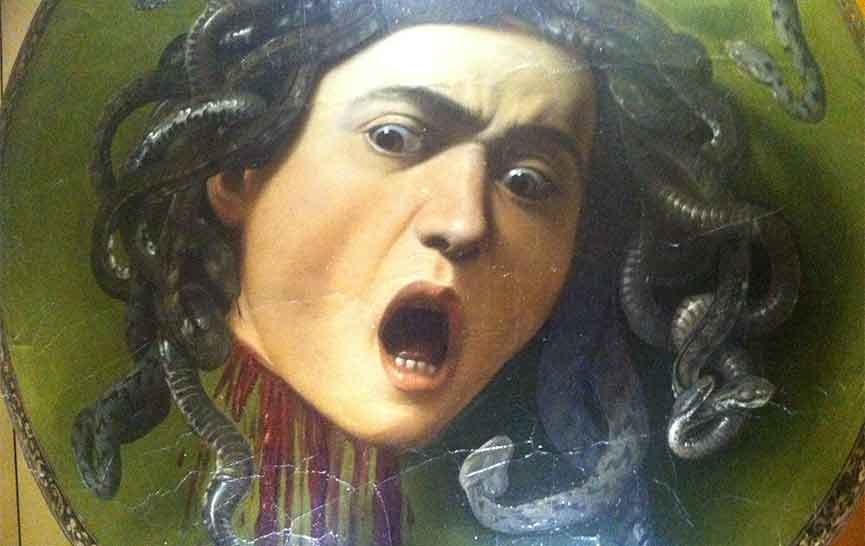
The Uffizi Gallery Collection has no equal in the world when it comes to Renaissance artists; the patronage of the Medici family quickly created a collection of works signed by the greatest artists of the time, today considered unreachable geniuses such as Michelangelo or Leonardo.
The itinerary of the visit starts from the second floor where there are 45 rooms arranged along the U-shaped plan of the building along which a long corridor runs. This is the floor that houses the major works in the collection: it starts with ancient statues and paintings that belonged to the Medici Collection. In these rooms there are the works of Leonardo Da Vinci, Botticelli, Lippi, Pollaiolo, Perugino, Signorelli, Bellini, Giorgione, Mantegna and Correggio.
Capolavori della Collezione della Galleria degli Uffizi
– Cimabue: Majesty of Santa Trìnita (1280-1300)
– Giotto di Bondone: All Saints Majesty (1310)
– Fra' Angelico: Coronation of the Virgin (1434), Thebaid (1420)
– Masolino: Sant'Anna Metterza (1424), Madonna of the tickle (1426)
– Masaccio: Child and the Virgin
– Piero della Francesca: Double portrait of the Dukes of Urbino
– Paolo Uccello: Battle of San Romano
– Botticelli: 15 works including The Birth of Venus, Spring, Madonna in Glory of Seraphim (1469), Madonna of the Rose Garden (1469), Portrait of a Man with Medal by Cosimo the Elder (1475), Madonna of the Magnificat (1483 ), Madonna of the Pomegranate (1487), San Barnaba Altarpiece (1487), San Marco Altarpiece (1490)
– Leonardo Da Vinci: Adoration of the Magi, Baptism of Christ, Annunciation
– Titian: Venus of Urbino (1538), Portrait of the bishop of Bologna Beccadelli (1552)
– Caravaggio: Medusa (1597), Bacchus (1598),
– Atermisia Gentileschi: Judith beheading Holofernes (1620)
– Rembrandt: Portrait of a rabbi (1665) |
|
History of the Uffizi Gallery in Florence
The history of the Uffizi Gallery is linked to the Medici family, bankers who rose to power in the 13th century and governed Florence for centuries, collecting works of art by the greatest artists of the time.
The Medici family used to commission the greatest artists of the time with works of art which were then exhibited in their palace.
In 1560, however, Cosimo I de' Medici brought together the 13 most important Florentine magistracies, called Uffici, in a single space that could be more easily supervised by him. The choice of location therefore obviously fell alongside the seat that had been the seat of power since the Republic of Florence, Palazzo Vecchio.
In charge of the project was the artist and architect Giorgio Vasari who designed a U-shaped building facing south on the Arno just near Ponte Vecchio. Furthermore, Vasari connected Palazzo Pitti to Ponte Vecchio and the Uffizi to Palazzo Vecchio with the famous Vasari Corridor. Once the building was completed, the magistrates took office but, as early as 1581, the top floor was destined to house the works of the Medici collection which continued to grow until 1743 when the last male heir of the Medici, Gian Gastone, died. His sister, Anna Maria Luisa, survived him for 6 years, before extinguishing the dynasty forever, but she put them out well because she obtained from her successors, the Lorraines, the promise that the collection would remain in Florence forever.
Pietro Leopoldo di Lorena decided to open the Uffizi Gallery to the public in 1769, creating the museum we know today. |
|
How to reach the Uffizi Gallery in Florence
The Uffizi Gallery is located in the square of the same name next to the central Piazza della Signoria, right in the center of Florence.
Arrive by train
From Santa Maria Novella Station you can reach it on foot in about 15 minutes (1400 m).
Arrive by bus
The closest bus stop is the Uffizi Gallery on the C1 line (210 meters from the Gallery).
Arrive by car
The closest car parks are Garage Palazzo Vecchio, Garage dei Tintori, Garage Lungarno (for a fee). They are located just 300 meters on foot from the Uffizi Gallery. |
|
|
|


